The Challenger Brief / Issue 01
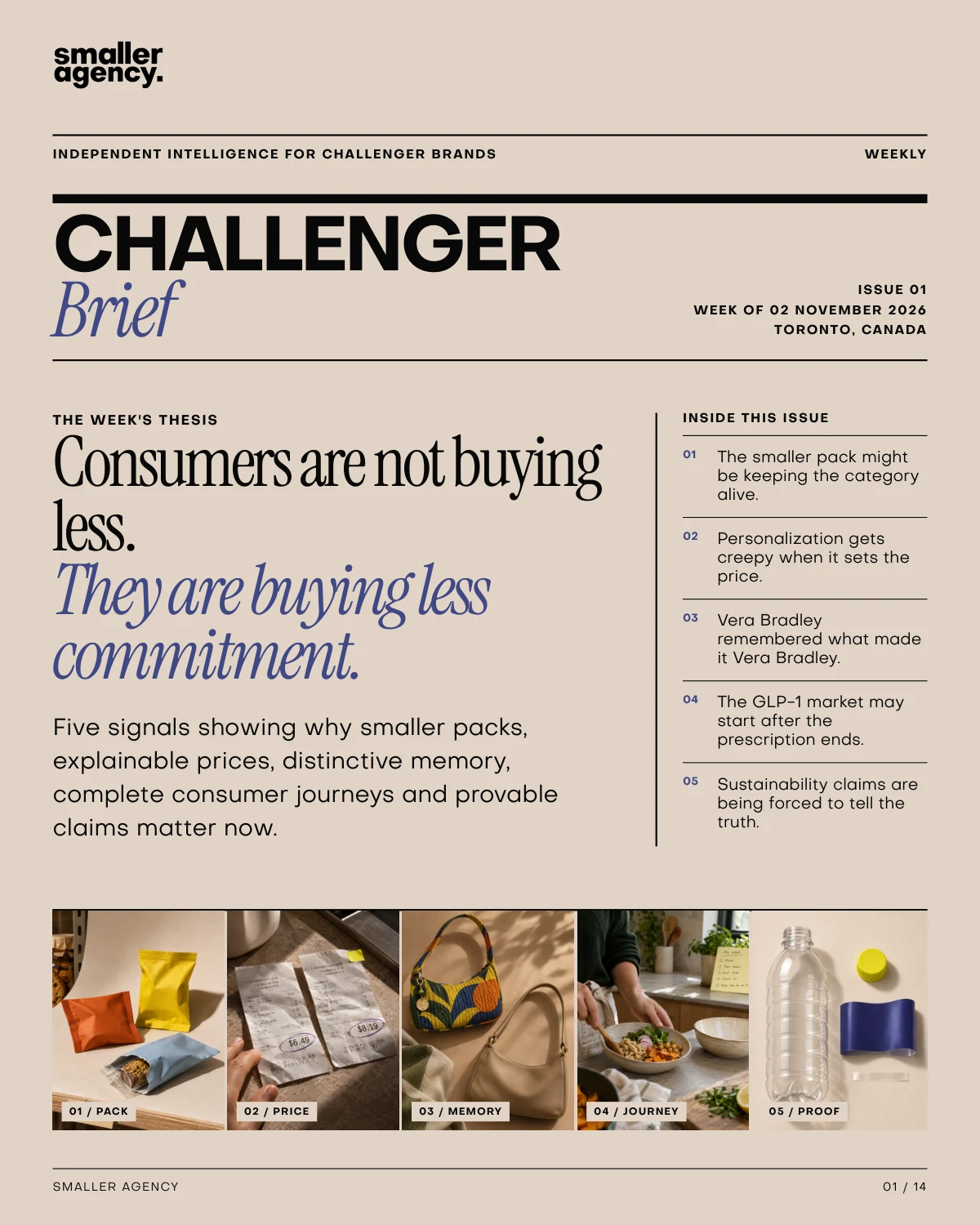
Consumers are not buying less. They are buying less commitment.
Five signals showing why smaller packs, explainable prices, distinctive memory, complete consumer journeys and provable claims matter now.
Week of 02 November 2026Toronto, Canada14 pages
The week’s thesis
The lazy read is that consumers are trading down. That is not quite what is happening.
People still want the treat, the better product, the identity boost, the convenience and the result. What they are becoming less willing to accept is the commitment surrounding the purchase.
The basket.
The risk.
The reason.
The choice.
The promise.
The proof.
This week’s stories all point in the same direction. The brands earning attention are making the decision easier to enter, easier to understand and easier to trust. For challengers, that makes specificity more valuable than scale.
01
The smaller pack might be keeping the category alive.
Price-pack architectureStrong and structural
The story
US Halloween chocolate sales fell by $33.1 million. But small-pack sales rose 24% while every larger pack size declined.
Consumers also moved toward reduced-sugar candy, popcorn, bars, rice cakes and other portion-controlled alternatives. Meanwhile, major consumer businesses are warning that higher energy, freight and material costs could bring further price increases in 2027.
Why we’re talking about it
The pack is becoming part of the value proposition. Consumers are not necessarily giving up the occasion. They are reducing the financial and psychological commitment required to participate in it.
That makes price-pack architecture a brand decision, not simply a revenue-management exercise.
Smaller implication
Trial sizes, single occasions, smaller multipacks and mixed bundles can preserve permission to buy without teaching people to wait for a discount. The line is transparency. Quietly shrinking an existing pack creates resentment. Giving a smaller format a clear job creates access.
The Smaller takeThe smaller pack is not always shrinkflation. Sometimes it is the only reason the purchase still happens.
- Give each format a distinct occasion.
- Keep the value equation visible.
- Protect hero-product recognition.
Sources: Reuters, 30 October 2026 and Reuters, 27 October 2026.
02
Personalization gets creepy when it determines the price.
Pricing trustStrong direction / unsettled evidence
The story
The US Federal Trade Commission is examining whether personal data is being used to determine prices, wages or offers.
The investigation does not prove that every company is using individualized pricing. It does show that regulators increasingly see invisible price variation as a consumer-protection issue.
Why we’re talking about it
Relevance collapses when the customer suspects extraction. For years, brands have described personalization as a service: a better recommendation, a relevant offer, a shopping experience built around you. That framing fails when the same data appears to calculate the maximum amount you can be charged.
Smaller implication
Pricing governance is now part of brand trust. Loyalty offers, platform pricing and targeted promotions need rules that can be explained in plain language. This is where AI materially changes the market: it can make millions of individualized pricing decisions that are difficult to observe or compare.
The Smaller takePersonalization stops feeling personal the moment it determines how much more you can afford to pay.
- Make the pricing rule explainable.
- Audit marketplace variation.
- Measure trust beside conversion.
Source: Reuters, 28 October 2026.
03
Vera Bradley’s turnaround started when it remembered itself.
Brand modernizationStrong branding case
The story
Its 2024 modernization added solid colours, leather and a revised identity. The brand looked more contemporary and less like Vera Bradley.
The replacement strategy brought back cotton, prints and familiar brand assets while updating products around shoulder bags, charms and customization. The company then reported its first quarterly revenue growth in nearly five years and sold more than 24,000 units through TikTok Shop.
Why we’re talking about it
Modernizing a brand is not the same as making it look like modern branding. The successful work was not a nostalgic restoration. It identified the assets that carried memory and recognition, preserved them, then changed how they appeared in the product and channel.
Consumers carry less because much of their lives now sits on their phones. The product changed with the behaviour. The brand did not have to abandon itself.
Smaller implication
Separate modernization from conformity. Before changing an identity, identify which assets are tired and which are valuable precisely because people remember them. Change the use, assortment and expression before discarding the memory structure.
The Smaller takeA brand can become more contemporary and less relevant at exactly the same time.
- Audit memory before aesthetics.
- Modernize use before identity.
- Keep what competitors cannot own.
Source: Modern Retail, 27 October 2026.
04
The GLP-1 market may become larger after the prescription ends.
Category creationEmerging and important
The story
Atkins is repositioning around consumers who have stopped taking GLP-1 medications and want support maintaining their weight.
Atkins sales declined 20.9%, so the execution is unproven. But the need state is real. Research cited by Food Dive suggests that as much as two-thirds of lost weight can return during the year after discontinuation.
Why we’re talking about it
The category is not a drug. It is the complete behavioural journey. Most food and wellness brands are fighting for relevance during treatment: high protein, smaller portions, muscle support and nutrient density. Far fewer are designing for preparation, adjustment, transition and long-term maintenance.
Smaller implication
The answer is not adding GLP-1 language to an existing high-protein product. Brands need to understand the specific behavioural moment they are entering. Portioning, digestion, muscle maintenance and the return of appetite are different problems. Claims will require careful substantiation.
The Smaller takeThe largest GLP-1 consumer market may eventually be people who are no longer taking GLP-1s.
- Map the complete journey.
- Design for a specific moment.
- Substantiate every health claim.
Source: Food Dive, 2026.
05
In Canada, the package is part of the claim.
Canadian green claimsStructural and enforceable
The story
Canada’s Competition Bureau now makes clear that environmental claims are judged by their overall impression, including words, images and layout.
Claims must be truthful and not misleading, with proper testing or substantiation where required. A technically accurate sentence can still create a misleading impression when the package suggests more.
Why we’re talking about it
Greenwashing can be a design problem before it becomes a legal one. Canada’s standard looks beyond literal wording to the general impression. Colour, icons, photography, qualifiers and hierarchy all matter. The evidence burden no longer sits with copy alone. It sits with the system.
Smaller implication
Build a claims matrix for every Canadian package: exact words, evidence, visual cues and affected component. Review the package as a consumer sees it, not as a lawyer parses it.
The Smaller takeA claim does not need to be literally false to create the wrong impression.
- Map every environmental claim.
- Audit the full package impression.
- Link every claim to proof.
Hype watch
Signal, not spectacle.
$14B
The scenario
A University of Chicago study estimates the annual cost of one hypothetical US front-of-package labelling system.
The signal
A formal definition of ultraprocessed food could eventually reshape formulation, product naming and packaging across most grocery categories.
The hype
The FDA definition remains under review. It would not itself create a labelling mandate. Do not redesign around a rule that does not exist.
Source: Food Dive, 27 October 2026.