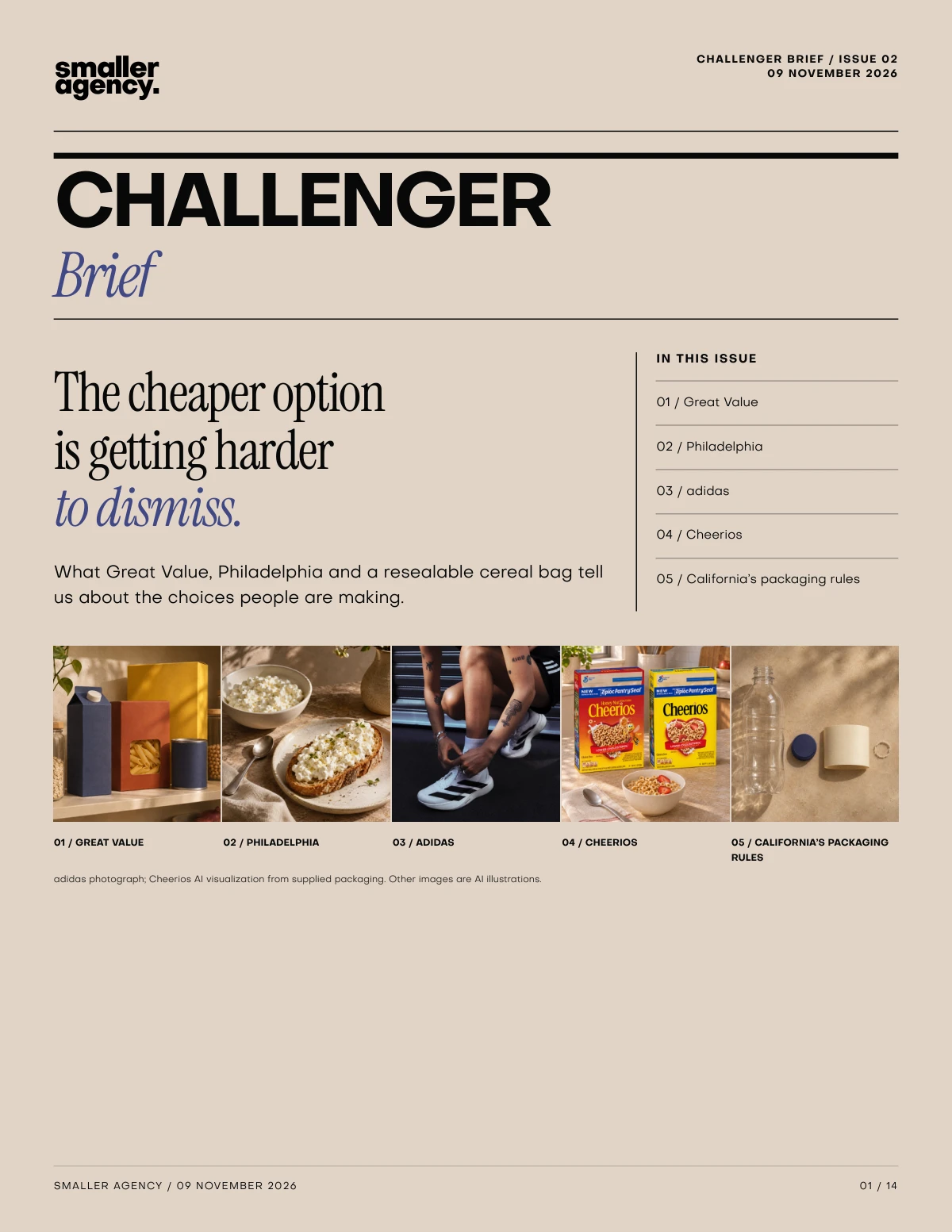
The Challenger Brief / Issue 02
The cheaper option is getting harder to dismiss.
What Great Value, Philadelphia and a resealable cereal bag tell us about the choices people are making.
The Great Value redesign puts a fairly uncomfortable question in front of branded products: if the cheaper option looks good and does what you need, why pay more?
Walmart Canada is bringing a more consistent identity to Great Value across more than 100 categories. Nearly 150 products are expected to move to the new packaging next year. That gives the brand a lot of opportunities to become familiar during an ordinary grocery shop. Walmart Canada ↗
For a smaller food brand, that changes the comparison. Your packaging might have looked distinctive beside an older store-brand pack. Now the product next to yours could look just as considered, be easier to understand and cost less. You need to know what someone values about your product beyond the way it looks.
That could be taste, an ingredient they care about or a format that fits their day better. The answer will be different for each brand. But it has to be something the customer notices, rather than something that only sounds convincing in the presentation.
And sometimes, the alternative they choose won't be in the category you've been watching.
Philadelphia is finding that out.
US cottage-cheese sales rose 17.7% in the year to October 4, while cream-cheese sales fell 4.4%, according to Circana figures reported by Business Bearings, citing MarketWatch. Kraft Heinz has acknowledged that protein-forward alternatives are putting pressure on Philadelphia's category. Source ↗
It's easy to build a competitive review around the other cream cheeses. The packs sit together. The products are similar. You can compare price, flavour and claims without leaving the aisle.
But someone making breakfast may be thinking about something else entirely. They might want more protein, or have seen a recipe they want to try. From their point of view, cottage cheese can become an alternative even though the brands put themselves in different categories.
That's a useful thing to understand before commissioning new positioning or packaging. If people are leaving, find out what they're buying instead and why. Otherwise, you can spend a lot of time improving your answer to a question they have stopped asking.
A product benefit gives people something to come back for.
The adidas results offer another angle on this. Its Performance business grew 14% in the third quarter on a currency-neutral basis, compared with 3% in Lifestyle. The company also pointed to excess inventory and discounting in lifestyle footwear. Those conditions matter; these results don't tell us that people have suddenly stopped caring about style. adidas ↗
What interests me is how much more there is to work with when the product has a clear purpose. A running shoe can be part of someone's identity and still need to feel good on a long run. The design, the community and the performance can support each other.
For a challenger, I'd want to understand that relationship before building a lifestyle around the brand. What are people actually doing with the product? What gets better when they use it? That's where the story starts to feel believable, because it connects to something they experience themselves.
Sometimes that improvement is much less ambitious than a new technology or a whole new product.
A cereal bag that closes properly would be a good start.
Cheerios has introduced a resealable inner bag with Ziploc, including an opening designed to make pouring easier. General Mills says 90% of cereal consumers already take extra steps to preserve freshness, citing a December 2025 survey. The US launch began on October 27. General Mills ↗
Anyone who has rolled down a cereal bag and hunted through a drawer for a clip understands the problem. The product comes in a box, but keeping it usable becomes your responsibility as soon as you open it.
We spend a lot of time thinking about what packaging does on shelf. This is a reminder to follow it home. How does it open? Where does it live? What happens when someone uses it for the fourth or fifth time?
Those details can feel small during a design review. They're less small when a customer deals with them every morning. A useful packaging improvement might come from watching someone struggle with the current version for five minutes.
There is a balance to work through, though. Adding a feature can also add material, cost or another part to deal with.
That makes California's packaging rules worth watching.
Under SB 54, California measures plastic source reduction by both weight and number against a 2023 baseline. The collective target reaches 25% by January 2032. Producers contribute through the approved producer responsibility organization plan; it isn't an identical reduction requirement applied separately to every company. CalRecycle ↗
The design question is practical. If a package has a bottle, cap, seal and sleeve, making each piece a little lighter leaves you with the same number of pieces. It's worth asking whether all of them are needed before spending time improving each one.
For Canadian brands planning to sell in California, I'd bring that discussion into development early. A change to the closure can affect how the product is used. Removing a seal may affect protection. These decisions need the packaging designer, supplier and product team working through the same problem.
The Cheerios example and the California rules aren't pointing to one universal packaging answer. They show why the whole experience needs attention. A package should be easier to use, protect the product and make sense to produce. Working out the trade-offs is part of the design work.
One to watch: sports-drink flavours in alcohol.
Constellation paid US$75 million at close for SpikedAde in October, with up to US$278 million in further payments tied to performance. The brand combines sports-drink-inspired flavours with vodka. Constellation's announcement ↗
I can see why a familiar flavour would make a new drink easier to try. I'd still want to know what brings someone back after the first can. Is it the taste, the occasion or the novelty? The acquisition tells us there is commercial interest. Repeat purchase will tell us more about whether this has somewhere to go.
That is where I'd leave this week's brief. Before changing how a brand presents itself, spend some time understanding why people choose it and what happens after they do. The answer might call for a clearer pack. It might call for a better product, or a change that looks fairly ordinary in a presentation but makes someone's day a little easier.